
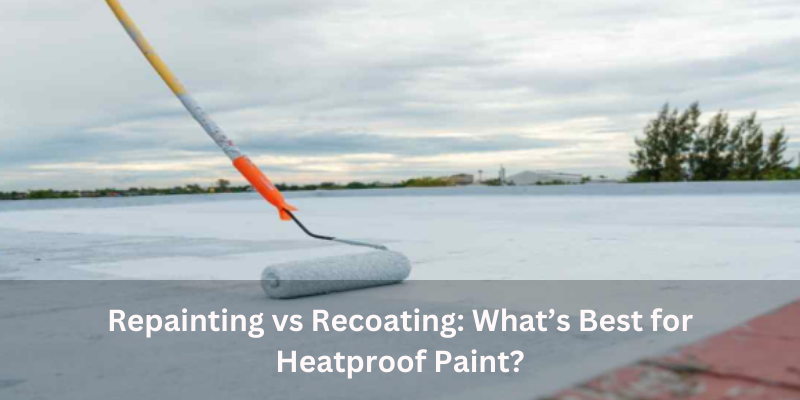
Repainting vs Recoating: What’s Best for Heatproof Paint?
People often compare repainting and recoating when searching for heat proof paint because both claim to reduce heat, improve comfort, and extend surface life. The choice directly impacts how much heat is reflected, how long protection lasts, and how much money is spent initially and over time. Selecting the wrong approach can lead to poor thermal performance, frequent maintenance, or unnecessary costs. This guide clearly explains repainting versus recoating, why the difference matters, and how each option performs in real conditions. By the end, readers will understand which method suits their surface condition, climate exposure, durability needs, and budget expectations.
What is Heat Proof Paint?
Heat-proof paint is a specialized coating designed to reflect solar radiation and reduce surface heat absorption. Its primary purpose is to lower surface temperatures, minimize heat transfer indoors, and improve thermal comfort. These coatings work by using reflective pigments, ceramic microspheres, or insulating additives that deflect infrared and ultraviolet rays. As a result, less heat penetrates the structure, reducing cooling load and energy consumption. Heat proof paint is commonly applied on rooftops, exterior walls, terraces, and industrial sheds where direct sun exposure is high. It is widely used in residential, commercial, and industrial environments facing extreme heat conditions.
What Does Repainting Mean?
Repainting refers to applying a completely new paint system after thorough surface preparation. It usually involves cleaning, repairing cracks, removing loose or damaged paint, applying primer, and finishing with heat proof paint layers. This method creates a fresh bonding surface, ensuring maximum adhesion and performance. Repainting is recommended for old, weathered, peeling, or moisture-affected surfaces where existing paint integrity is compromised. Roofs with structural wear, walls with flaking coatings, and surfaces receiving heatproof paint for the first time typically require repainting. Although more time-consuming and costly, repainting delivers stronger durability, better heat reflection, and longer-lasting thermal protection.
What Does Recoating Mean?
Recoating means applying a fresh layer of heat proof paint over an existing, stable paint surface without complete removal. It differs from repainting because it requires minimal surface preparation, focusing mainly on cleaning and minor repairs. Recoating is technically suitable when the existing paint is intact, well-bonded, and free from major cracks, peeling, or dampness. This method is commonly used for maintenance, reflectivity restoration, or performance enhancement. Recoating is faster and more cost-effective than repainting but depends heavily on the condition of the previous coating. When done correctly, it can restore heat resistance and extend service life efficiently.
Repainting vs Recoating: Key Differences
While both approaches use heat proof paint, they differ significantly in preparation, durability, and effectiveness.
| Parameter | Repainting | Recoating |
| Surface condition required | Suitable for damaged, old, or peeling surfaces | Requires stable, intact existing paint |
| Surface preparation | Extensive cleaning, repairs, priming | Basic cleaning and minor touch-ups |
| Initial cost | Higher due to labor and materials | Lower and budget-friendly |
| Time required | Longer application time | Faster completion |
| Labor intensity | High | Moderate |
| Heat resistance performance | Maximum and consistent | Moderate to high, depends on base layer |
| Adhesion strength | Strong, fresh bonding | Relies on existing paint adhesion |
| Durability | Long-term performance | Medium-term performance |
| Maintenance frequency | Less frequent | More frequent over time |
| Best use case | First-time application or major restoration | Maintenance and reflectivity refresh |
If long-term heat reduction and durability are priorities, repainting often proves more reliable. Recoating works well when surfaces are already in good condition and need cost-effective thermal enhancement.
Which Option Delivers Better Heat Reduction?
Heat reduction performance depends largely on surface condition and application method. In high-temperature climates, repainting generally delivers superior heat reduction because it creates a fresh, uniform reflective layer with stronger adhesion. For first-time heat proof paint applications, repainting is more effective, as existing coatings may not support optimal reflectivity. In maintenance scenarios, recoating can still reduce heat if the base layer remains intact. Roofs experience harsher solar exposure than walls, so repainting roofs often yields better results, while walls with stable paint can benefit adequately from recoating in practice today.
When Should You Choose Repainting?
Repainting should be chosen when surfaces show visible deterioration or structural wear. Common signs include peeling paint, deep cracks, chalking, water stains, and uneven textures. Structural indicators such as moisture seepage, thermal expansion damage, or exposed substrate strongly suggest repainting is necessary. Beyond appearance, repainting restores proper adhesion and allows heat proof paint to perform at its full potential. Long-term benefits include improved durability, consistent heat reflection, fewer maintenance cycles, and better protection against weather extremes. It is especially valuable for older buildings or first-time heat proof paint applications projects.
When is Recoating the Smarter Choice?
Recoating becomes the smarter choice when existing paint is intact, well-adhered, and free from major defects. Ideal surfaces show no peeling, minimal cracking, and no signs of dampness or substrate exposure. Recoating suits maintenance cycles where heat reflectivity needs restoration rather than complete renewal. It works well for periodic upgrades on previously treated roofs and walls. From a budget perspective, recoating offers faster application, lower labor costs, and reduced downtime. It is best for property owners seeking efficient heat performance improvement without the expense of full repainting or surface replacement.
Cost Analysis: Repainting vs Recoating
In the short term, recoating is more affordable because it involves less surface preparation, lower labor costs, and reduced material usage. Repainting requires higher upfront investment due to repairs, priming, and multiple application stages.
However, repainting often delivers better heat performance from the start, which can translate into improved energy savings over time, especially in high-temperature regions where cooling costs are significant.
From a long-term perspective, repainting usually offers better value for money. Its longer lifespan reduces maintenance frequency and reapplication cycles. Recoating may need more frequent touch-ups, increasing cumulative costs despite lower initial spending.
Final Verdict: Repainting or Recoating?
Choosing between repainting and recoating ultimately depends on surface condition, performance expectations, and long-term planning. If the surface is damaged, aged, or receiving heat proof paint for the first time, repainting remains the most reliable choice. For well-maintained rooftops needing performance renewal, recoating delivers faster, cost-efficient results.
Brands like HeatCure simplify this decision by offering advanced rooftop coating solutions in India and roof coating in Dubai. With warranties of up to ten years, adjusted for climate and location, HeatCure ensures predictable performance. The final call should balance surface health, climate severity, budget, and desired lifespan rather than short-term savings alone for building owners. Consult our rooftop coating experts now.
Comment (0)