
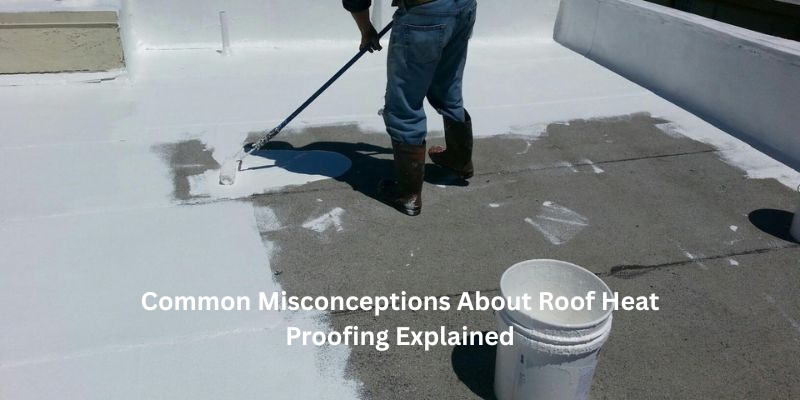
Common Misconceptions About Roof Heat Proofing Explained
As scorching summers become the new normal in many parts of India, more homeowners are exploring roof heat proofing (sometimes called cool-roof solutions or solar reflective coatings). Yet, misconceptions and half-truths abound, and they often lead people to skip good solutions, choose the wrong product, or expect what’s simply impossible. In this article, we’ll unpack the most common myths surrounding roof heat proofing, set the record straight, and help you make smarter choices. At HeatCure, we believe clear knowledge is the foundation of effective cooling.
Why Roof Heat Proofing Is Important Today
Before diving into myths, let’s remind ourselves: your roof is the first line of defense against solar heat gain. In a tropical or semi-tropical climate, direct sunlight can push roof surface temperatures to 60–80°C (or more), which then radiates heat downward into your living spaces.
A well-engineered heat-reflective coating or system can reduce roof surface temperatures by 20–30°C (or more) and bring down indoor ambient temperatures by 3–8°C depending on design, insulation, and local climate. High solar reflectance and high emissivity are the two key properties that make these systems effective.
When done right, roof heat proofing helps:
- Lower cooling loads on air conditioning (thus reducing electricity bills)
- Improve indoor comfort (especially in rooms directly under the roof)
- Extend roof lifespan (by reducing thermal stresses and UV damage)
- Contribute to sustainable building design
But many homeowners hesitate because of misconceptions. Let’s bust those.
Myth 1: “Roof Heat Proofing Is Just Paint”
Reality: It’s far more than ordinary paint.
A widespread belief is that roof heat proofing is just applying a coat of white paint to your roof. That’s misleading. Ordinary paints don’t have the spectral properties needed to reflect heat in the infrared (IR) bands, nor do they withstand UV, thermal cycling, and weathering over time.
True heatp roof coatings solution are engineered with special pigments, nanoparticles, and binders that:
- Reflect a high portion of solar radiation (across UV, visible, and IR spectra)
- Exhibit high emissivity (i.e., they can radiate away whatever heat they absorb)
- Maintain adhesion, flexibility, and durability under temperature swings
- Resist weather, moisture, dust, and micro-cracking
In many markets, manufacturers promote a “cool roof” or “heat reflective coating” as a distinct product category separate from conventional paints.
At HeatCure, our formulations are designed specifically for roof heat mitigation.
Myth 2: “Any White Paint Works Equally Well”
Reality: Reflecting visible light isn’t enough.
Yes, white surfaces reflect visible light, but much of solar heat comes from infrared radiation that ordinary white pigments do little to counter. A “whitewash” may keep your roof looking cooler in bright sun, but under heat, it will still absorb and transmit significant IR radiation.
The proper performance metric here is Solar Reflectance Index (SRI) or spectral reflectance across IR and visible bands. A high-quality heatproof coating will maintain high reflectivity even as dust and aging set in. Some premium coatings reflect up to 90–95% of solar energy.
Furthermore, ordinary paint lacks durability under thermal expansion and UV attack. It may chalk, peel, or discolor rapidly.
Myth 3: “Heat Proofing Is Too Expensive for Homes”
Reality: The long-term payoff often justifies the cost.
When you compare the upfront investment with long-term savings in electricity and roof maintenance, heatproofing can deliver compelling returns. In hot climates, reduced cooling energy alone can cover a substantial fraction of the initial cost over a few years.
For example, some reflective coatings claim a 20–30% reduction in air conditioning load. Over a 5-10 year horizon, that can amount to tens of thousands of rupees in savings, especially in large homes or those using HVAC heavily.
Add to that extended roof life, fewer thermal cracks, lower maintenance, and the intangible benefit of increased comfort, and the value becomes clear.
Of course, success depends on the right product, proper application, and realistic expectations. But dismissing heat proofing as “too expensive” often stems from comparing low-grade or misapplied coatings, not high-performance solutions.
Myth 4: “Heat Proofing Damages Roof Structure or Waterproofing”
Reality: A well-chosen formulation enhances roof integrity.
Some worry that applying a heat-reflective coating might interfere with roof waterproofing systems or cause delamination. While improper application can cause issues, that risk exists with any rooftop coating, not just heatproofing.
A correct coating should:
- Be compatible with existing waterproofing membranes, sealants, and substrates
- Be flexible (able to expand/contract) without cracking
- Exhibit good adhesion, even on aged surfaces
- Offer UV resistance, self-cleaning behavior, and resistance to fungal or moss growth
Many advanced coatings are engineered to complement waterproof layers rather than disrupt them. A well-applied heatproof coating can reduce thermal stress, which actually helps preserve the waterproofing membrane underneath.
At HeatCure, we rigorously test our coatings on common Indian substrates (RCC, metal sheets, tiles, etc.) to ensure compatibility and longevity.
Myth 5: “It Doesn’t Work in Humid or Rainy Conditions”
Reality: High-grade coatings are designed for all-weather performance.
It’s true that extreme humidity, rain, and monsoon cycles pose challenges. But good heatproof coatings are engineered for exactly those challenges: they resist moisture ingress, UV degradation, fungal growth, and thermal cycling.
Many modern coatings are rated for 8–12+ years of exterior exposure. In India, a number of manufacturers already market coatings claiming high durability in tropical conditions.
In monsoon-prone zones, the best practice is:
- Ensure proper surface preparation, sealing cracks, and ensuring the roof is dry before application
- Use multi-layer systems (primer + reflective coat + protective top coat)
- Perform periodic cleaning (to remove dust, debris, algae)
- Choose coatings with self-cleaning and UV stabilization additives
When done properly, heatproofing works year-round, not just in sunny months.
Myth 6: “It Needs Frequent Reapplication”
Reality: Premium coatings last many years with minimal maintenance.
A common fear is that these coatings degrade quickly. You’ll need to reapply them every few years. That may hold true for low-tier products, but high-quality coatings are designed to last. Many claim a service life of 7 to 10 years (or more).
In practice, maintenance is mostly limited to:
- Occasional cleaning (dust, leaves, pollen)
- Inspecting for cracks or damage (e.g., after storms)
- Touch-up rather than full recoat
A well-installed system can stay effective for many cycles, making the cost and disruption manageable. HeatCure’s warranty and durability traceability back this claim.
Myth 7: “Heat Proofing Is Only for Industrial Buildings, Not Homes”
Reality: Residential applications see equal or greater benefit.
Too often, people assume roof heatproofing is only for factories, warehouses, or commercial buildings. But many heatproofing installations are residential, and the benefits are often felt more acutely in homes, where comfort and utility savings are individually significant.
Homeowners gain:
- Improved indoor comfort, especially in top-floor bedrooms or attic rooms
- Better resale or green-building appeal
- Visible results (cooler roof surfaces, lower indoor temperature)
- Alignment with sustainable, energy-conscious living
In fact, several public projects in India and elsewhere have applied reflective coatings to residential slums, achieving measurable indoor temperature reductions and energy savings.
Whether your roof is flat, sloped, concrete, tile, or metal, there are formulated coatings now that adapt to those surfaces. HeatCure routinely deploys residential projects, proving it’s not just for industrial sheds.
How to Choose the Right Roof Heat-Proofing Solution
After debunking myths, here’s a practical selection guide tailored for homeowners:
| Feature | Why It Matters | What to Look For |
| Solar Reflectance / SRI | Determines how much incoming solar energy is rejected | High SRI values (≥ 100) or ≥ 80–90% reflectance |
| Emissivity | Ability to radiate heat away | Emissivity close to 0.9–0.95 |
| Durability & Warranty | Ensures long-term value | 7–10+ years, UV resistance, crack resistance |
| Compatibility | For roofs with waterproofing, membranes, tiles, etc. | Adhesion, flexibility, compatibility with substrates |
| Maintenance & Cleanability | Dust and pollutants degrade performance | Self-cleaning surfaces, hydrophobic additives |
| Thermal Stress Resistance | Handles expansion/contraction cycles | Elastomeric or flexible formulations |
| Brand & Technical Support | Installation matters more than product alone | Support, certified applicators, demonstration projects |
Before applying, do a mini pilot patch and measure surface temperature drop on sunny days versus uncoated areas. That gives direct validation for your climate.
Why Homeowners Trust HeatCure
At HeatCure, we don’t just sell coatings. We engineer solutions. Here’s what sets us apart:
- Nanotech-Infused Coatings We incorporate advanced nano-pigments and reflectors to maximize reflectance across UV, visible, and IR spectra.
- Rigorous Testing & Real-World Data Our lab and field trials in Indian climates validate that our coatings reduce roof surface temperatures by up to 20–25°C and indoor ambient temperatures by 4–6°C.
- Cross-Substrate Compatibility Our formulations work on concrete, metal sheets, tiles, and composite decks without harming waterproof membranes.
- Long-Term Warranty & Service We back our product with certified applicators, periodic maintenance checks, and extended warranty options.
- Local Climate Optimization HeatCure is tuned for Indian heat, humidity, and weather cycles. Our R&D uses real local data.
- Sustainability Mindset Low-VOC, eco-friendly formulations. Each successful roof helps mitigate urban heat island effects and reduce energy consumption.
Thousands of home and commercial projects across India have already felt the difference. We don’t promise magic. We deliver measurable cooling, durability, and energy efficiency.
Conclusion:
Misconceptions about roof heat proofing continue to prevent many homeowners from adopting solutions that could dramatically improve comfort and efficiency. But the facts are clear:
- Heatproofing is far more than paint
- Ordinary white paint isn’t good enough
- Upfront cost is offset by energy savings
- Good coatings safeguard the roof
- With proper selection, it works in humid, rainy climates
- It doesn’t need frequent reapplication if done well
- And it absolutely can work for your home
If you’re considering roof cooling for your house, ask the right questions: what is the SRI, what’s the warranty, what’s the expected temperature drop, and who does the installation?
At HeatCure, we believe in transparency, performance, and service. Reach out to our experts today. Let us help you choose a system that cools, protects, and pays for itself over time. Stay cool confidently.
Comment (0)